Know if your "factory" is real before you wire the deposit.
A 7-factor scoring system to vet any Chinese supplier before you wire: the same checklist I run on the floors myself, in Shanghai, every week. Comes with an interactive field tool you use live on your iPhone or iPad.
One-time payment. No subscription.
Vetting a Chinese supplier means confirming it is a real, licensed factory, not a trader with a rented showroom, before you wire a deposit. This 7-factor system scores legal entity, factory-vs-middleman, capacity match, quality system, financial terms, communication signals, and track record, using the same checklist run on Shanghai factory floors every week. It comes two ways, a PDF to study, and an interactive field tool you run on your iPhone or iPad in the factory: tap the checks, it auto-scores the supplier, and you take notes on the floor. When you're done, one tap sends the finished report to your manager by WhatsApp, iMessage, or email.
Vet the supplier before you trust them.
Walk all seven factors, score each 1 to 5 on what you actually verified, and the weighted total plus the go or no-go verdict update in real time.
Vetting Score
Red flag
Beneficiary bank name doesn’t match the business licence. Do not wire.
It's 11 p.m. and your finger is over the button. The quote came in low, the rep answered in minutes, the sample looked perfect. So you wire the 30% deposit. What you don't know yet: the "factory" is a guy with a website and a rented showroom, and he's about to sub your order to a plant he's never met. The fastest, friendliest, cheapest supplier is almost never the real one. By the time the container's late, it's already too late.
I'm in these buildings every week, steel mills, electronics lines, heavy-equipment plants, and I run this exact checklist before I let a dollar leave my own account. Last month a "factory" claiming 200 workers showed registered capital of about $15,000 on China's free government registry. That mismatch is the whole game, and it takes two minutes to check once you know where to look. So I put the whole thing on paper. Seven factors, checked in order, scored on a sheet. Above the line, you proceed with terms that protect you. Below it, you walk, no matter how good the price looks. It's the read of a guy who's physically inside these plants, not a template that guesses.
What you get
- •The 7-factor framework, in the exact order I check them: Legal Entity, Factory vs. Middleman, Capacity Match, Quality System, Financial Terms, Communication Signals, Track Record
- •A weighted scorecard, seven factors weighted by how often each one is what actually burns you, scored to 80, with clear Proceed / Proceed-with-caution / Walk thresholds
- •Red-flag vs. green-flag boxes for every factor: the precise tells that separate a real maker from a trader in disguise
- •Verification moves, step by step: check the 18-digit Unified Social Credit Code on China's free government registry, spot a fake ISO cert, read payment terms as an X-ray of their finances
- •A copy-paste first-contact message that reads as an experienced buyer: surfaces most red flags in one exchange and gets you the A-team and better pricing
- •A clean PDF field manual: instant download, yours to keep, run it on every order you ever place
- •PLUS a bonus interactive field tool, the whole system as an app on your iPhone, iPad, or touchscreen: tap the checks, it auto-scores the supplier, you take notes on the floor, right in your browser. Reuse it forever.
This one's my gift to you, built to use, not just read.
Here's something I put in this system for you, free: an interactive field checklist you actually use on the floor. Not just to study at your desk, to run live when you walk into the factory, on your iPhone, your iPad, or any touchscreen. Reuse it on every supplier, as many times as you want.
I built it because I got tired of my own notebook. You're standing in a plant, you've got to pull the pen out, write it down, keep the pages straight. It's slow, and it's 2026. So I made the thing I wanted: you tap the checks, it scores the supplier for you, it gives you the verdict, and you jot your notes right under each factor. I started using it myself last week, and honestly it changed how I walk a floor.
And here's the part I love: when you're done, you don't retype a thing. One tap sends the finished report, the score, the verdict, your notes on every factor, straight to your procurement manager back home, by WhatsApp, iMessage, or email. Your agent walks the floor; the boss has the report the same minute.
And this is just the start. My team and I are building more of these through September, field tools you can carry into any factory, anywhere in the world. That's where The Factory Floor is going: not documents you read once, but working apps you use on the ground.
- ▸Runs on iPhone, iPad, or any touchscreen: opens in Safari or Chrome, nothing to install; add it to your Home Screen to keep it one tap away
- ▸Tap the checks, score each factor, get an instant Proceed / Caution / Walk verdict
- ▸Type notes under every factor as you go, saved on your device, ready to print or reuse
- ▸One tap sends the finished report to your manager, WhatsApp, iMessage, or email, straight from the factory floor
- ▸Yours to reuse on every supplier, forever, nothing extra to pay
Who it's for
For importers, Amazon FBA and private-label sellers, and procurement leads sourcing from China, whether it's your first order or your hundredth.
But, couldn't I do this myself?
"I can just Google a checklist or ask ChatGPT." Sure. And it'll tell you what to ask. It won't tell you what a real factory's answer is supposed to sound like, where they hide the margin, or which "yes" actually means no. A trader will smile and agree to everything; that's the tell, and a template can't hear it. You're not buying a document. You're buying the read of someone who's in these buildings every week.
Who's behind it
I'm Cengiz Gündüz. 25 years in cross-border trade, now on the ground in Shanghai, walking supplier floors and running audits every week. I sell industrial equipment out of China myself, so I've got no supplier to push and no kickback in your order. The same eyes I use on my own money, pointed at yours.
What it's worth
One bad first order is a 30% deposit gone across a border with no recourse. For most buyers that's tens of thousands of dollars. This is $17. Less than the lunch you'd buy the supplier, and one wrong wire costs more than this will across a lifetime of orders. You'll place the next order eventually. Run this before that wire, not after. Cheap insurance on an expensive mistake.

Cengiz Gündüz - The Factory Floor
25 years in global trade. The last stretch on the ground in Shanghai, walking the factory floors myself. I sell industrial equipment out of China too, so I've got no supplier to push and no kickback in your order.
Solo operator. I personally answer every email.
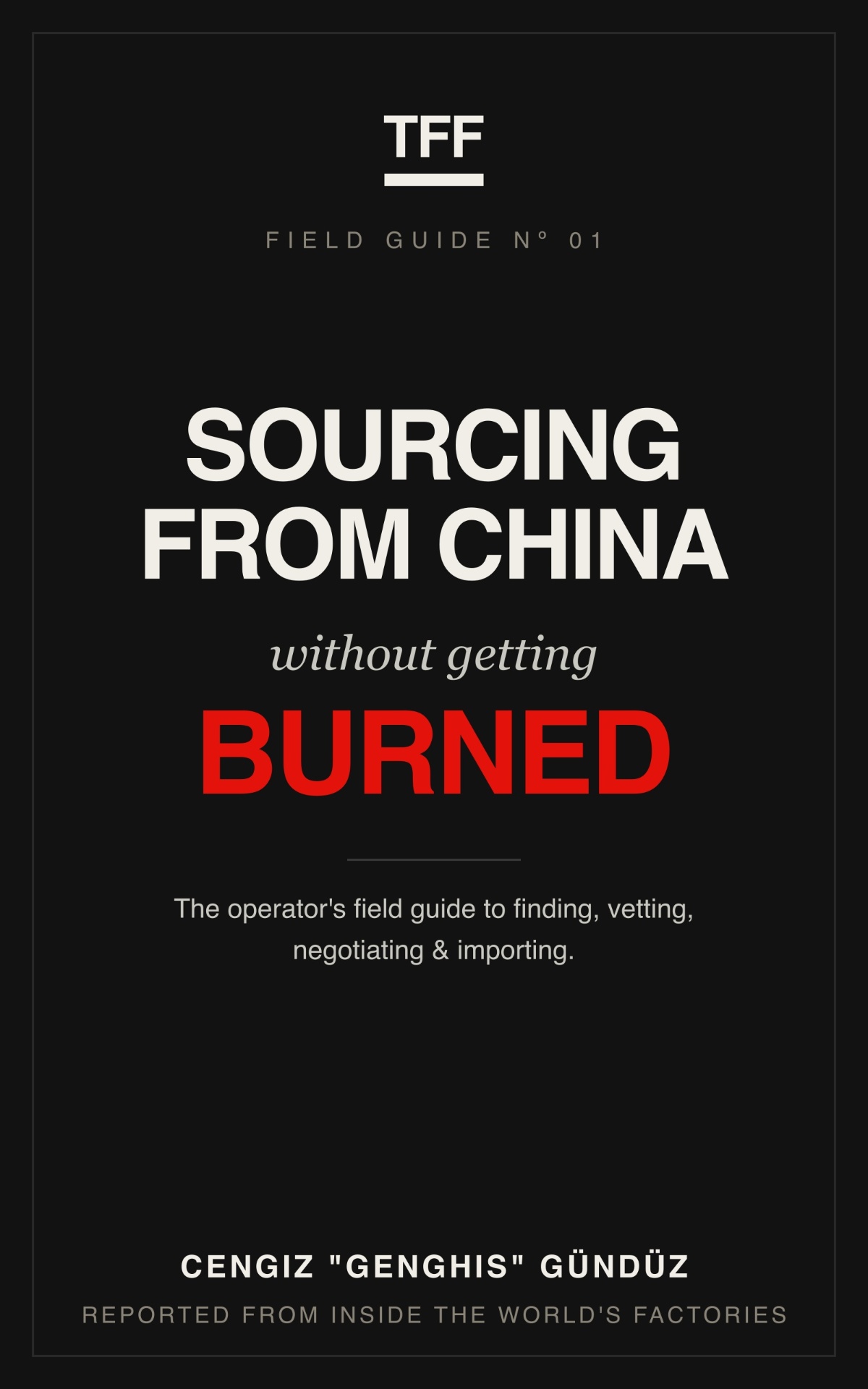
Author of "Sourcing From China Without Getting Burned", on Amazon Kindle.
The "Don't Get Burned" Guarantee
Use it on your next order. If it doesn't save you a headache, or a dollar, email me within 7 days and I'll refund you in full. No forms, no hoops. I'm one operator in Shanghai, and I answer every email myself. Cengiz
One-time payment. No subscription.
You get it two ways: the PDF to study, and the interactive field tool to run live on your iPhone or iPad in the factory. Instant download, yours to keep, reuse it on every order. The price is paid once, the value compounds. A working field kit, not a blog post: built to be run before every wire, not read once.
From the people I work with
Trusted on the ground, not just online.
“In hardware, we often say that relationships are the foundation, not just a transaction. Cengiz completely embodies this philosophy. He has an incredible knack for bridging the gap between Western buyers and complex manufacturing landscapes. If you are a brand looking to qualify factories before wiring capital, source verified partners in China, or secure heavy industrial equipment, Cengiz is your guy. He doesn't just make introductions; he builds the trust and oversight needed to actually get things built right. I couldn't recommend him more highly.”
“I bought one of the contracts and used it directly with my factory in China. It saved me from paying a lawyer close to a thousand dollars for something fairly basic, and it covered exactly the points I needed protected. Two months later I'm still working with the same supplier, and everything runs smoothly. For any Western buyer who wants real protection without the big legal bill, this is worth it. Thank you to The Factory Floor.”
“Thank you for your continued support and your readiness to help. I sincerely appreciate it. I will keep in touch whenever anything is required. Wishing you and your team continued success.”
What's inside
- •A 7-factor scoring sheet you run on any Chinese or Asian factory before you wire a deposit: score it, see your dollar exposure, get a clear proceed / caution / walk call
- •The 18-digit Unified Social Credit Code check: how to pull a supplier's registration on the official government registry and confirm the company actually exists and is licensed to do what they claim
- •The trader vs. factory test: the questions and signals that separate a real manufacturer from a middleman reselling someone else's line at a markup
- •A side-by-side red-flag / green-flag list for the things buyers miss on Alibaba: borrowed photos, mismatched company names, deposit-only payment, a 'factory' that can't answer a process question
- •A dollar-exposure estimate so you know what's actually at risk on this order, not just a vague 'feels sketchy'
- •A written action plan: the exact order you check things in, so nothing gets skipped under deadline pressure
- •A copy-paste first-contact message engineered to surface fraud in a single reply
- •Instant PDF download. Keep it forever. Reuse it on every new supplier you ever talk to.
Why it matters
The costly mistake this prevents is wiring a deposit to a company that isn't the factory it claims to be. Most importers learn how to vet a Chinese supplier the expensive way: after a 30% deposit is gone, the samples never match production, or the 'factory' turns out to be a trader who outsourced your order to a shop you never approved. Before any money moves, you need to verify the China factory is real: confirm the legal entity behind the 18-digit Unified Social Credit Code, separate a trader from a true manufacturer, and run an Alibaba scam check on the signals that don't show up in a glossy profile. I run this exact 7-factor system on my own orders out of Shanghai before I commit a dollar. It costs less than the cheapest mistake it stops, and you can answer 'is my supplier a real factory?' before you're emotionally and financially committed instead of after.
FAQ
How do I vet a Chinese supplier before I pay a deposit?
Run a structured check, not a gut feel. Confirm the legal entity exists on the official Chinese government registry using the 18-digit Unified Social Credit Code, verify the business scope actually covers your product, check whether you're talking to the real factory or a trader, and pressure-test the relationship with a first-contact message designed to expose fraud. This system walks you through all seven factors in order and ends with a score so you get a clear go/no-go before any money moves.
How can I tell if my supplier is a real factory or just a trader?
Traders reselling another factory's line usually can't answer specific process or capacity questions, dodge a factory video call, give a company name that doesn't match the bank account, and resist letting you inspect. A real manufacturer can show you the line and speak to its own process. The trader vs. factory section gives you the exact questions and tells that separate the two so you stop paying a middleman markup on an order you think is going direct.
What is the Unified Social Credit Code and how do I check it?
It's the 18-digit ID on every registered Chinese company, the equivalent of a business registration number. You can look it up on China's official enterprise registry to confirm the company legally exists, is in good standing, and is licensed for the business it claims. Most Western buyers never run this check. The system shows you exactly where to look and what each result means.
How do I do an Alibaba scam check?
A 'Gold Supplier' badge is paid placement, not verification. It doesn't prove the company is a real factory or that the photos are theirs. The real check is matching the company name to the bank account, confirming the legal entity behind the listing, watching for deposit-only payment demands and borrowed product photos, and verifying the factory will get on a live video call. The red-flag / green-flag list covers the signals that actually predict a problem.
Is this legal advice or a guarantee I won't get scammed?
No. This is an operator's vetting framework, not legal advice, and no checklist can guarantee an outcome. What it does is dramatically lower your odds of wiring money to a fake or misrepresented factory by making you check the things that matter before you commit. For a large order or contract, have qualified counsel review your agreement separately.
Do I need to be in China or speak Chinese to use this?
No. Every check is built for a Western buyer working remotely in English. The registry lookup, the first-contact message, and the scoring all work from your desk. It's the same discipline I use on the ground in Shanghai, written so you can run it without being here.