You cave forty cents a unit because you don't have the next line ready.
The exact lines I send Chinese factories every week to move price and hold terms, each one paired with a note on what their reply really means and what to say back.
One-time payment. No subscription.
Negotiating with Chinese suppliers works through calibrated, face-saving asks tied to volume, payment terms, or a longer relationship. Not pressure or loud demands. This pack gives 40+ copy-paste scripts for price, payment terms, quality claims, reopening stalled deals, and clean exits: each with notes on what the factory's reply actually means.
You're on the call. You ask for a better price and you get the line everyone gets: "This is already our best price, very low margin for us." So you go quiet. You split the difference in your head. You cave forty cents a unit because you've got nothing loaded to say next. Multiply that across 5,000 units and every reorder after it. The factory didn't beat you. Your silence did.
I'm in these buildings every week, and I've sat on both sides of this table. The buyers who win aren't the toughest talkers. They're the ones who already know what the supplier's about to say and have the next line loaded. So I wrote the lines down. This is the exact language I use to move price, hold terms, restart a supplier who's gone quiet, and raise a quality problem without torching the relationship. You read it, you paste it, you send it.
What you get
- •40+ copy-paste scripts across the 5 situations that actually decide your margin: every line in plain English, ready to send as-is
- •Price-move scripts: the counters that get past 'this is already our best price' without insulting the supplier or killing the deal
- •Payment-terms scripts: shift off a fat upfront deposit toward 30/70, inspection-gated terms that keep your money protected until you've seen the goods
- •Reopen-the-stall scripts: the message that gets a supplier who's gone silent for nine days to answer and start moving your order again
- •Quality-claim scripts: how to raise a bait-and-switch or defect the way that gets it fixed, instead of an apology and a shrug
- •Clean-exit scripts: walk away from a bad supplier without burning the bridge or surrendering the hold your deposit gives you
- •A one-line read under every script: what their answer is supposed to sound like, where the real 'no' is hiding, and how to hold your ground
Who it's for
For importers, FBA and private-label sellers, and procurement leads doing their own negotiating, especially if this is one of your first real China orders.
But, couldn't I do this myself?
"I'll just wing it or ask ChatGPT for a template." A template tells you what to type. It can't tell you that "no problem" often means there's a problem, that a fast "yes" to everything is the trader's tell, or which polite refusal is actually an opening to push. These scripts come with the read (what the answer is supposed to sound like and what to say next) from a guy who hears these exact lines in person every week.
Who's behind it
Cengiz Gündüz has spent 25 years in cross-border trade and now works on the ground in Shanghai, walking real factory floors every week. He sells industrial equipment out of China himself, so there's no supplier to push and no kickback to collect. The same language he uses on his own orders, handed to you.
What it's worth
One soft negotiation costs you more than this in a single order. Cave forty cents a unit on a 5,000-unit run and you've handed back $2,000, then handed it back again on every reorder. The whole pack is less than the freight on a single pallet. Worst case, you're out $47. Best case, you hold your price on the next call and the pack pays for itself a hundred times over. You buy it once and run these scripts on every supplier, every order, for as long as you import.

Cengiz Gündüz - The Factory Floor
25 years in global trade. The last stretch on the ground in Shanghai, walking the factory floors myself. I sell industrial equipment out of China too, so I've got no supplier to push and no kickback in your order.
Solo operator. I personally answer every email.
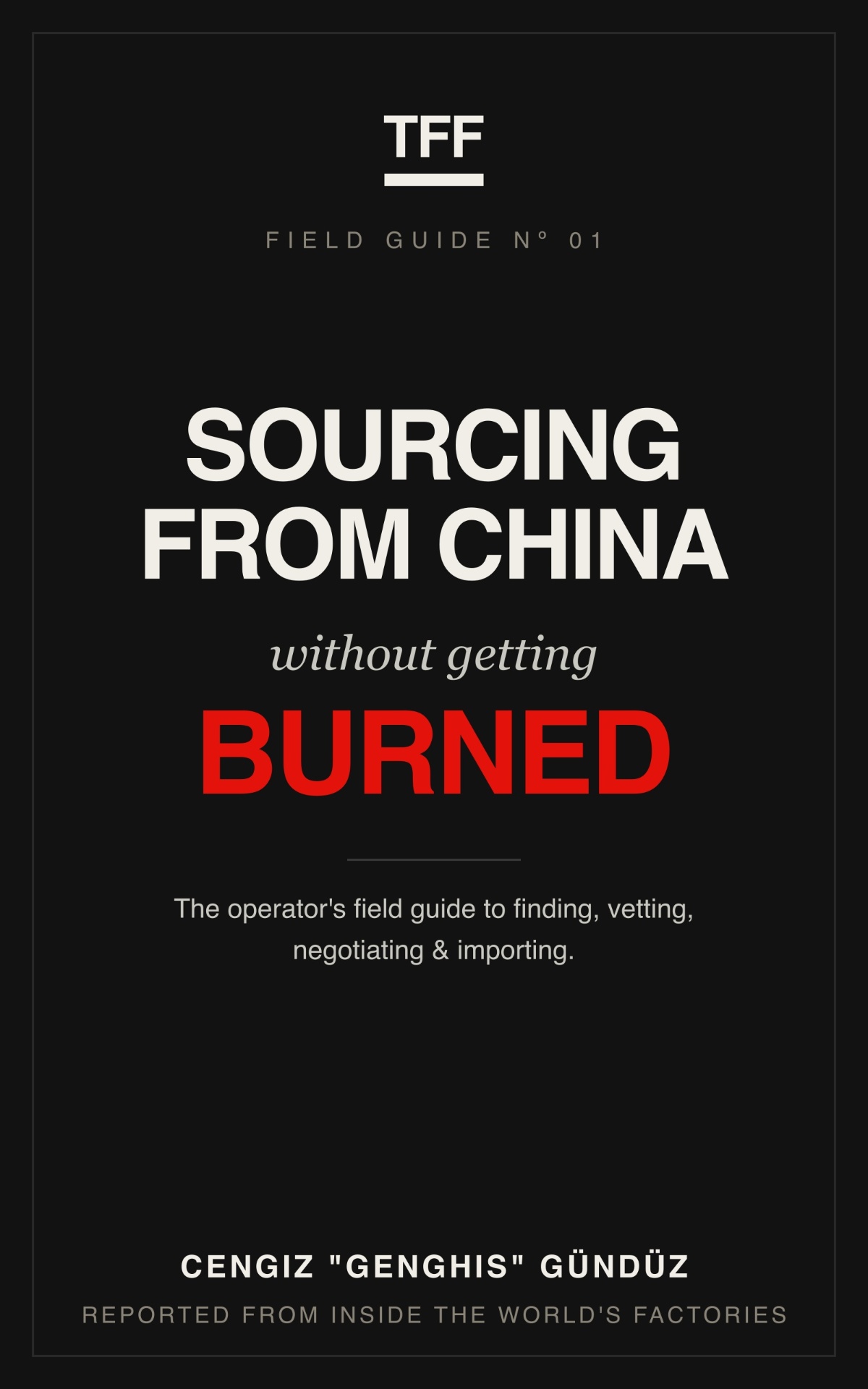
Author of "Sourcing From China Without Getting Burned", on Amazon Kindle.
The "Don't Get Burned" Guarantee
Use it on your next order. If it doesn't save you a headache, or a dollar, email me within 7 days and I'll refund you in full. No forms, no hoops. I'm one operator in Shanghai, and I answer every email myself. Cengiz
One-time payment. No subscription.
Instant download. Yours to keep. Run it on every supplier and every order you ever place. Cheap insurance on an expensive conversation.
From the people I work with
Trusted on the ground, not just online.
“In hardware, we often say that relationships are the foundation, not just a transaction. Cengiz completely embodies this philosophy. He has an incredible knack for bridging the gap between Western buyers and complex manufacturing landscapes. If you are a brand looking to qualify factories before wiring capital, source verified partners in China, or secure heavy industrial equipment, Cengiz is your guy. He doesn't just make introductions; he builds the trust and oversight needed to actually get things built right. I couldn't recommend him more highly.”
“I bought one of the contracts and used it directly with my factory in China. It saved me from paying a lawyer close to a thousand dollars for something fairly basic, and it covered exactly the points I needed protected. Two months later I'm still working with the same supplier, and everything runs smoothly. For any Western buyer who wants real protection without the big legal bill, this is worth it. Thank you to The Factory Floor.”
“Thank you for your continued support and your readiness to help. I sincerely appreciate it. I will keep in touch whenever anything is required. Wishing you and your team continued success.”
What's inside
- •40+ copy-paste scripts for the moments that actually decide your margin: opening the quote, pushing back on 'best price,' and closing the gap
- •Scripts to move price without blowing up the relationship: the lines that get a real number instead of a face-saving 'it's difficult'
- •Scripts to shift payment terms off deposit-heavy 30/70 toward something that protects your cash
- •Scripts to reopen a stalled supplier who's gone quiet, and to restart a deal that died on price
- •Quality-claim scripts: how to raise a defect, demand a remedy, and hold terms without torching the supplier
- •Clean-exit scripts: the polite walk-away that often brings the real price back, and how to leave a supplier without burning the bridge
- •For every script, a read on what the supplier's reply actually means, so you know whether 'let me check with my manager' is real or a tactic
- •Calibrated for Western buyers dealing with Chinese factories, built around face, relationship, and patience, not generic sales-training lines
- •Instant download. Paste straight into WeChat or email. Reuse on every supplier, every order, forever.
Why it matters
The costly mistake this prevents is leaving 10 to 25 percent on the table because you said the one wrong thing: pushing when you should have waited, or accepting the first number because you didn't know how to move it. Most Western buyers lose money negotiating with Chinese suppliers not on price knowledge but on signal-reading: they hear 'it's a little difficult' and back off, they take silence as a no, they corner a supplier into protecting their margin instead of opening it. Learning how to negotiate with Chinese suppliers is mostly learning what the reply means and which exact line moves it. These are supplier price negotiation emails and messages you copy, paste, and send, each one tied to a read on what the factory actually meant. It's the difference between a quote that drops and one that doesn't, on every order you ever place.
FAQ
How do I negotiate a better price with a Chinese supplier?
Don't open with a number and don't corner them. Anchor with a calibrated ask, give them a face-saving way to move, and read the reply before you push again. The pack gives you the exact opening message, the 'best price' pushback, and the follow-ups, plus a read on what each response really means, so you know when the price has more room and when it's genuinely at the floor.
What's the best way to ask a supplier to lower the price by email?
A flat 'can you do better?' invites a flat 'this is already our best price.' The supplier price negotiation emails in this pack tie the ask to volume, payment terms, or a longer relationship, and give the factory a reason and a way to move without losing face. You copy the script, drop in your numbers, and send it straight into email or WeChat.
What does it mean when a supplier says 'it's a little difficult' or 'let me check with my manager'?
Usually it's not a no. It's a soft signal that there's room, or a stall to test your patience. 'A little difficult' often means possible but they want something in return; 'let me check with my manager' can be real or a tactic to slow you down. Every script in the pack comes with this read, so you respond to what they meant instead of what they said.
How do I reopen a deal with a supplier who went silent?
Silence is rarely a final answer. There are specific re-engagement scripts here for the supplier who stopped replying after your last counter and for the deal that stalled on price, written to reopen the conversation without looking desperate or giving up your position.
Do these work for handling a quality problem or defect claim?
Yes. There are scripts for raising a defect, demanding a remedy, and holding your terms on a quality claim, calibrated so you get the outcome without destroying a supplier you may want to keep working with.
Are these generic negotiation tips or specific to China?
Specific to China. Generic Western sales-training lines often backfire with Chinese factories because they ignore face and relationship. Every script is calibrated for a Western buyer dealing with a Chinese supplier, and each includes why it works so you understand the power, not just the words.
What to get next
The buyers who get the most from this pair it with the tools below. Each one protects the next step.